
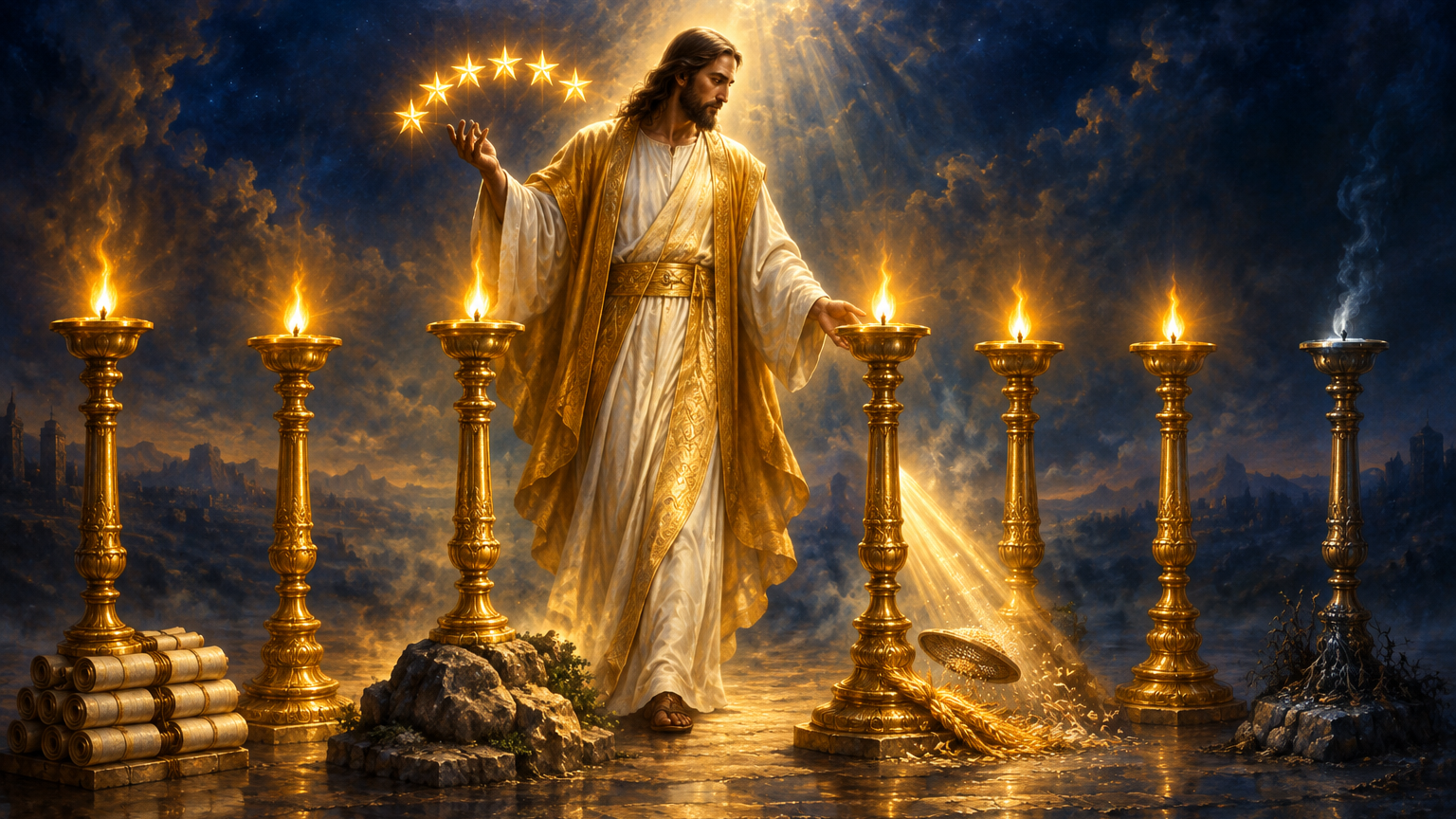
The risen Lord speaks first to Ephesus, the leading church of Asia, from the island of Patmos about ninety kilometres across the Aegean. This congregation had been planted in a city of trade, magic, and the great temple of Artemis, and it had known the long labours of Paul, Timothy, and John. Forty years on, Jesus still walks among His churches. He praises their hard work, their patience, and their hatred of false teaching, then lays His finger on the wound that would kill them if left alone: they had abandoned the love they had at first. Orthodoxy without affection is not victory. The One who holds the stars and tends the lampstands calls them to remember, repent, and return, and He promises the tree of life in the paradise of God to the one who conquers.
Podcast Episode


Video Summary
Commentary
Revelation 2:1
“To the angel of the church in Ephesus write: ‘The words of him who holds the seven stars in his right hand, who walks among the seven golden lampstands.”
The letter is addressed to the ἄγγελος (angelos, ANG-gel-os) of the church, the messenger or leader who must receive and speak what Christ says. Ephesus sat near the mouth of the Cayster River on the west coast of Asia Minor, about five kilometres from the open sea in John’s day, the first stop on the Roman road that ran north to Smyrna and then inland through the other six churches. The Speaker is the One who κρατέω (krateō, krat-EH-oh) the seven stars in His right hand—He does not merely hold them; He grips them with authority, so that pastors and churches rest in His strength and not their own (Revelation 1:16, 20; John 10:28–29). He also περιπατέω (peripateō, peh-ree-pat-EH-oh) among the seven golden λυχνία (lychnia, look-NEE-ah), the lampstands that are the churches themselves. In the tabernacle the priest walked among the lamps to trim the wicks and pour the oil so that the light would not go out (Exodus 27:20–21; Leviticus 24:1–4); now the greater Priest walks among His people, seeing what no committee can hide. The church is not a club that owns its own light. It is a lamp in His hand, and He is present in the midst.
Revelation 2:2
“‘I know your works, your toil and your patient endurance, and how you cannot bear with those who are evil, but have tested those who call themselves apostles and are not, and found them to be false.”
Οἶδα (oida, OY-dah) is not a guess. The Lord knows their works with the knowledge of One who has watched every hour. He names their κόπος (kopos, KOP-os), labour that leaves a person spent, and their ὑπομονή (hypomonē, hoo-pom-on-AY), the staying power that remains under a load rather than throwing it off. This church could not bear those who were evil, and they tested men who claimed apostleship and found them liars, just as Paul had warned the Ephesian elders that wolves would rise from among themselves (Acts 20:29–31; 1 John 4:1). In a city famous for magic books and travelling teachers, that kind of testing was costly and necessary. Sound doctrine is not coldness; it is love for the flock that refuses to let poison pass as bread. Jesus sees the sweat and the refusals, and He does not treat them as small.
Revelation 2:3
“I know you are enduring patiently and bearing up for my name’s sake, and you have not grown weary.”
The praise is doubled so that no one can say He overlooked their faithfulness. They have endured and borne the weight διὰ τὸ ὄνομά μου—for His name’s sake—not for a reputation or a programme. Years earlier Paul had told this same church that God is able to do far more abundantly than all we ask or think, according to the power at work within us (Ephesians 3:20–21); they had not fainted under that calling. Weariness is the ordinary end of human effort, yet they had not grown weary, which means grace had held them when the city, the cult of Artemis, and the false apostles pressed in. The Lord notices the long obedience that never makes a headline. Still, the next sentence will show that endurance without first love is a lamp running low on oil. To labour for His name is good; to forget the Name-bearer Himself is the crack that lets the light out.
Revelation 2:4
“But I have this against you, that you have abandoned the love you had at first.”
One charge stands against all the commendation. They have ἀφίημι (aphiēmi, af-EE-ay-mee) their first ἀγάπη (agapē, ag-AH-pay)—not lost it by accident, but left it, sent it away, as a man might dismiss what he once held close. “First” is first in time and first in rank: the love that marked them when they burned the magic books and the Word prevailed (Acts 19:17–20), the love Paul had prayed would root them in Christ’s own love (Ephesians 3:17–19). The prophets had said the same of Israel: “I remember the devotion of your youth, your love as a bride” (Jeremiah 2:2), and then the bride grew busy and cold. Service had become the substitute for fellowship. They still hated error and still worked hard, but the heart that once ran to Him now ran the ministry instead. Jesus will not accept a church that is right about everything except Him.
Revelation 2:5
“Remember therefore from where you have fallen; repent, and do the works you did at first. If not, I will come to you and remove your lampstand from its place, unless you repent.”
Three commands follow the wound: remember, μετανοέω (metanoeō, met-an-o-EH-oh), and do the first works. Remember is not nostalgia; it is to bring the former height back into view so that the fall is no longer denied. Repent is a decisive turning of the mind that leads to a new path, not a vague sadness. The first works are the fruit of first love—prayer that seeks His face, the Word received with hunger, open-handed care, worship that is more than correct. If they will not, He Himself will come and move their lampstand from its place. That is not the loss of an individual’s salvation; it is the end of a church’s witness. History has already written the footnote: the harbour silted up, the city died, and no living congregation stands among those ruins. Light that will not burn with love is taken away, because a lampstand exists to shine, not to sit as furniture.
Revelation 2:6
“Yet this you have: you hate the works of the Nicolaitans, which I also hate.”
Mercy speaks again before the letter closes. They hate the works of the Νικολαΐται (Nikolaitai, nik-ol-ah-EE-tie), and the Lord says He hates those works too. The name itself means “conquerors of the people,” and Scripture later binds their teaching to the way of Balaam—eating food sacrificed to idols and sexual immorality under a banner of freedom (Revelation 2:14–15; Numbers 25; 31:16). In Ephesus that would have meant making peace with the guild feasts and the temple culture rather than bearing the shame of Christ’s name. Jesus does not hate the people as people; He hates the works that devour the flock. Hatred of what God hates is not a defect in love; it is love with a spine. The danger in Ephesus was that they kept the spine and lost the heart. The danger in other churches would be the reverse. Both errors kill, and the Lord will not choose between them.
Revelation 2:7
“He who has an ear, let him hear what the Spirit says to the churches. To the one who conquers I will grant to eat of the tree of life, which is in the paradise of God.”
The call widens from one congregation to every church and every hearer: the one who has an ear must hear what the Spirit says, the same summons that Israel knew in the Shema—hearing that obeys, not hearing that collects information (Deuteronomy 6:4). The promise belongs to the one who νικάω (nikaō, nik-AH-oh), who conquers—not the spectacular hero, but the believer who holds fast to Christ and will not leave first love for a polished substitute (1 John 5:4–5). He will eat of the ξύλον (xylon, KSOO-lon) of life in the παράδεισος (paradeisos, par-AD-ay-sos) of God. That word travelled from the Persian garden into the Greek Scriptures as the name of Eden (Genesis 2:8–9), the garden from which Adam was driven lest he eat and live forever in ruin (Genesis 3:22–24). What was barred at the east of Eden is opened again by the last Adam. The overcomer does not earn the tree; he receives it from the One who walks among the lamps and who will one day plant that tree by the river of the water of life (Revelation 22:1–2, 14). First love ends where it began: with God, and with life that cannot die.


Leave a Reply