
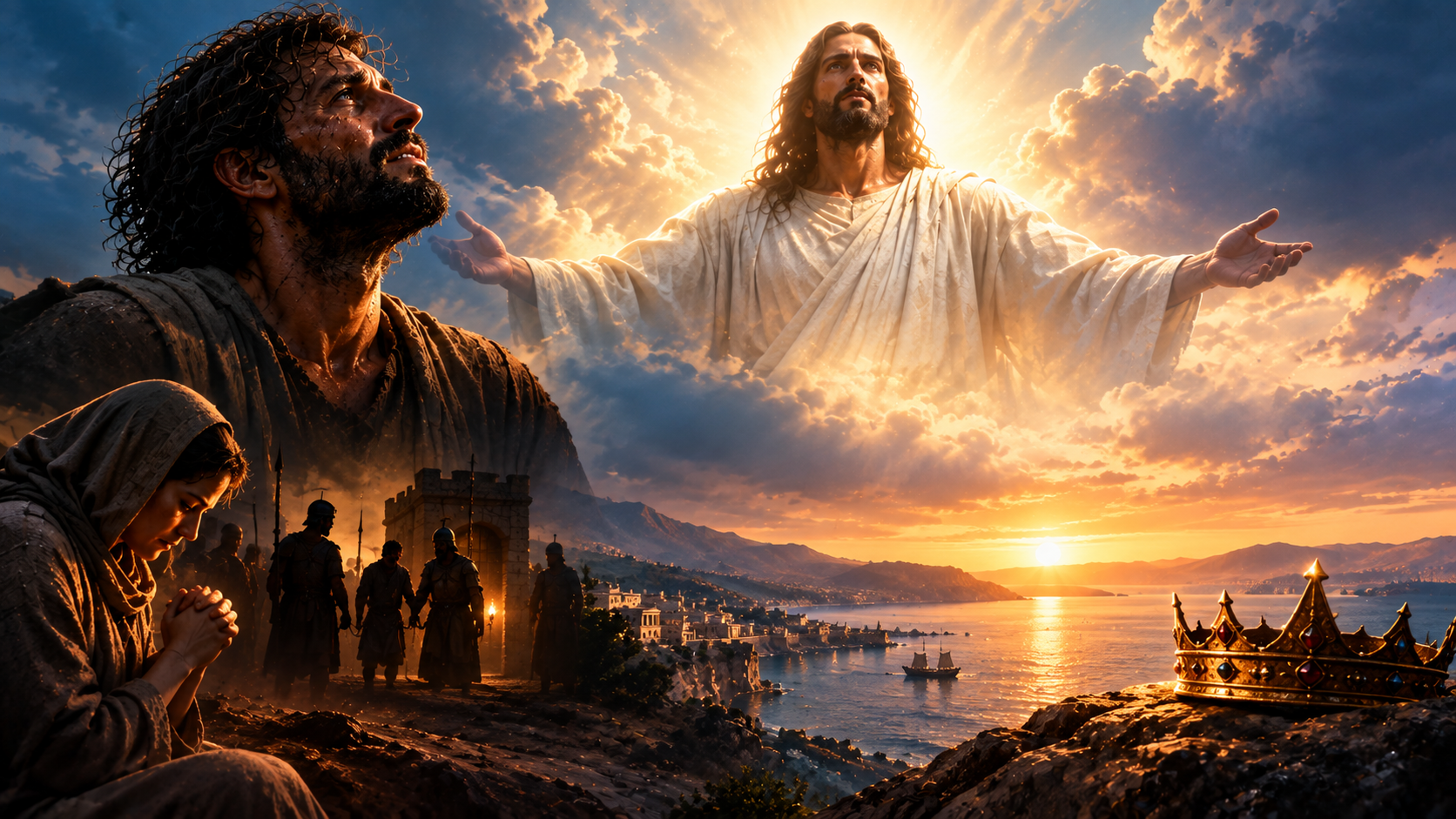
The letter to Smyrna is the second of the seven messages Christ dictates to John on Patmos. After Ephesus, the courier would travel north along the coastal road about sixty-five kilometres to this proud harbour city on the Aegean, the next stop on the circuit of the seven churches. Smyrna was famous for beauty, loyalty to Rome, and the emperor cult. The city’s own story is a picture of death and rising: old Smyrna was destroyed around 600 BC and lay in ruins for centuries before it was refounded and became one of the jewels of Asia. Into that setting Christ speaks as the One who Himself died and came to life. This is the only letter, along with the later word to Philadelphia, that contains no rebuke. The church is poor, slandered, and about to suffer more, yet the Lord calls them rich and promises a crown that outlasts every wreath the city ever hung on Mount Pagus.
Podcast Episode


Video Summary
Commentary
Revelation 2:8
“And to the angel of the church in Smyrna write: ‘The words of the first and the last, who died and came to life.’”
Christ addresses the messenger of the church and immediately names Himself with titles already given in the opening vision. He is πρῶτος (prōtos, PRO-tos) and ἔσχατος (eschatos, ES-kha-tos)—the First and the Last—language the Lord used of Himself through Isaiah when He declared that besides Him there is no God (Isaiah 44:6; 48:12). The same titles appear again at the close of the book (Revelation 22:13). He then adds that He ἐγένετο νεκρὸς καὶ ἔζησεν—He became dead and He lived. That is not a poet’s flourish. Smyrna itself had been razed and later raised; the believers there were staring at prison and the stake. The One who writes has already walked that road and come out the other side with the keys of death and Hades (Revelation 1:17–18). The Greek name of the city, Σμύρνα (Smyrnē), is the word for myrrh, the bitter resin used to wrap the dead (John 19:39) and to perfume the living. Their suffering would smell of burial, yet the Speaker is the Living One. He does not offer them escape from the grave so much as companionship in it and triumph beyond it.
Revelation 2:9
“‘I know your tribulation and your poverty (but you are rich) and the slander of those who say that they are Jews and are not, but are a synagogue of Satan.’”
The verb is οἶδα (oida, OY-dah)—I know, not as a distant observer but as One who has already seen and understood. Their θλῖψις (thlipsis, THLIP-sis) is pressure that crushes, the same word used for the birth pangs of a new age and for the afflictions of the last days. Their poverty is πτωχεία (ptōcheia, pto-KHI-ah), not mere tightness of purse but abject destitution, the condition of one who has nothing left to lose. In a city that lived by trade and by the emperor’s favour, refusing to say “Caesar is Lord” could cost a man his shop, his status, even his freedom. Yet Christ inserts the parenthesis that overturns the ledger: “but you are πλούσιος (plousios, PLOO-see-os)—rich.” James would later write that God has chosen the poor in the world to be rich in faith and heirs of the kingdom (James 2:5). The slander is βλασφημία (blasphēmia, blas-fay-MEE-ah)—speech that injures God’s name by injuring His people. Those who claimed the covenant name while rejecting the covenant’s King had become, in the Lord’s own verdict, a συναγωγὴ τοῦ Σατανᾶ (synagōgē tou Satana, soon-ag-o-GAY too sat-an-AH). Jews in the empire often enjoyed exemption from the emperor cult; some in Smyrna appear to have used that privilege as a weapon, informing on believers so that Rome would treat the church as a new and illegal sect. True Israel is defined by faith in the Messiah, not by bloodline alone (Romans 2:28–29; 9:6–8). The enemy of the saints is not finally a synagogue building but the adversary who stands behind every false claim to God’s people.
Revelation 2:10
“Do not fear what you are about to suffer. Behold, the devil is about to throw some of you into prison, that you may be tested, and for ten days you will have tribulation. Be faithful unto death, and I will give you the crown of life.”
The command is sharp and kind: μηδὲν φοβοῦ (mēden phobou)—fear nothing of the things you are about to suffer. Christ does not pretend the blow will miss. The διάβολος (diabolos, dee-AH-bo-los), the slanderer, will throw some of them into prison so that they may be πειρασθῆτε (peirasthēte, pay-ras-THAY-teh)—tested, proved, shown for what they are. The period is “ten days,” a phrase that recalls Daniel and his friends who asked for ten days of testing and were found better than those who ate the king’s food (Daniel 1:12–15). Ten days is long enough to hurt and short enough to be numbered. The Lord who is First and Last sets the clock; Satan may throw, but he does not own the calendar. Then comes the charge that has outlived every empire: γίνου πιστὸς ἄχρι θανάτου—become faithful all the way to death. The reward is not a διάδημα of royal gold but a στέφανος τῆς ζωῆς (stephanos tēs zōēs, STEF-an-os tace zo-ACE), the victor’s wreath that is life itself (James 1:12). Smyrna wore a famous “crown” of porticoes around Mount Pagus and awarded leafy crowns at its games and festivals. Christ promises a wreath that does not wither when the games end. A generation later Polycarp, bishop of this same church, would refuse to curse Christ and would receive that crown in the stadium, saying he had served his King eighty-six years and would not blaspheme Him now.
Revelation 2:11
“He who has an ear, let him hear what the Spirit says to the churches. The one who conquers will not be hurt by the second death.’”
The familiar refrain opens the letter to every church and to every age: the One who has an ear must hear what the Spirit is saying, not only to Smyrna but to the churches. The promise belongs to ὁ νικῶν (ho nikōn, ho ni-KOHN)—the one who conquers, the same word used of Christ Himself who has conquered (Revelation 5:5; 17:14). Conquest here is not the sword but steadfast faith unto death. The double negative οὐ μὴ ἀδικηθῇ (ou mē adikēthē) is as strong as Greek can make it: he shall in no wise be hurt, not even touched in the way that matters. The θανάτου τοῦ δευτέρου—the second death—is named later as the lake of fire (Revelation 20:14; 21:8). The first death may take the body; the second death is the endless ruin of those whose names are not in the book of life. The believers in Smyrna might lose everything visible, even breath itself, and still stand untouched by the death that never ends. That is why the letter can be so short and so unafraid. The church that looks poorest on earth is already rich, already crowned in promise, and already safe from the only death that can finally harm a soul.


Leave a Reply