
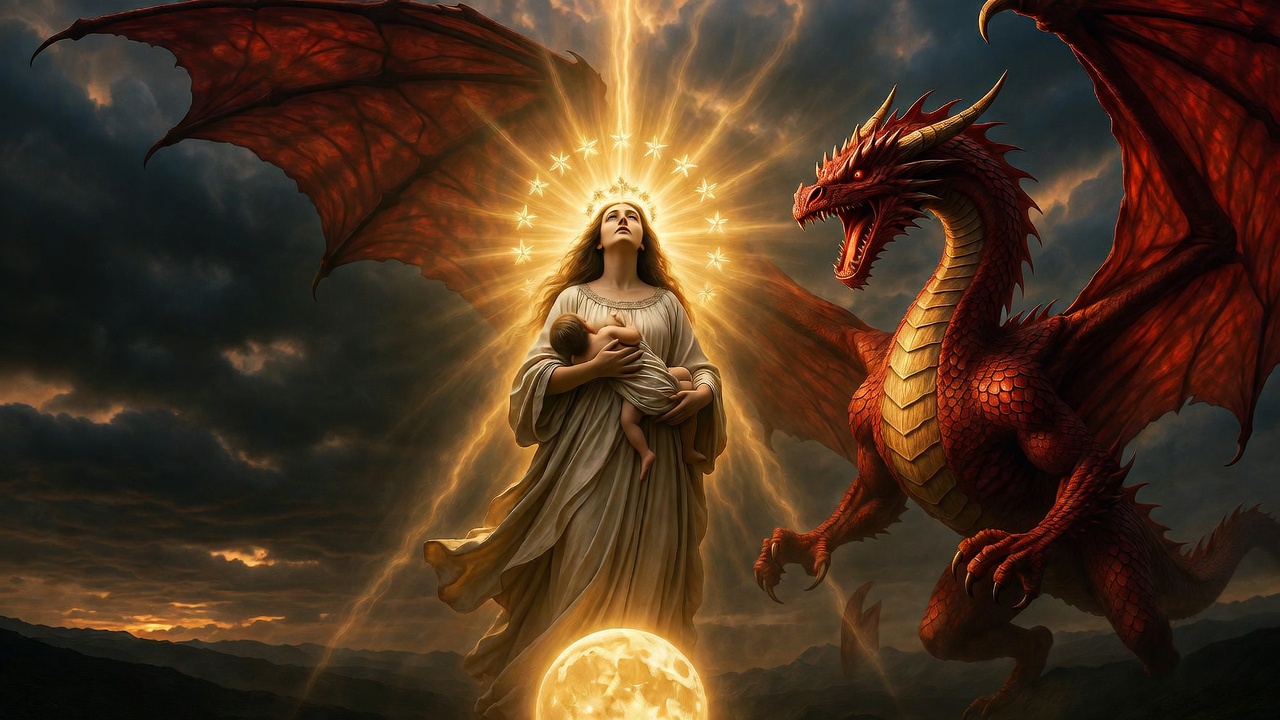
Revelation 12:1–5 presents a vivid heavenly vision that unveils the cosmic spiritual conflict surrounding the birth and victory of the Messiah. A radiant woman, symbolizing Israel, appears clothed with the sun, standing on the moon, and crowned with twelve stars — imagery that points back to God’s covenant people through whom the Savior would come. She gives birth to a male child destined to rule the nations, but a monstrous red dragon — identified later in the chapter as Satan — seeks to devour the child the moment He is born. Yet God sovereignly protects the child, catching Him up to His throne. This passage gives believers profound encouragement: though Satan rages against Christ and His people with ferocious hatred, God’s purposes cannot be thwarted, and Christ’s exaltation is certain.
The vision is not a chronological retelling of events but a symbolic panorama showing the enmity that began in Genesis 3:15 and reached its climax in the incarnation, death, resurrection, and ascension of Jesus. The dragon’s failure to destroy the child reveals that the cross was not Satan’s victory but his decisive defeat, and the ascension guarantees Christ’s ultimate triumph.
Podcast Episode


Video Summary
Commentary
Revelation 12:1
And a great sign appeared in heaven: a woman clothed with the sun, with the moon under her feet, and on her head a crown of twelve stars.
John sees a “great sign” (Greek sēmeion) — a symbolic portent that points to spiritual realities rather than a literal woman in the sky. The woman represents Israel, the covenant nation through whom the Messiah came . The sun speaks of majestic splendor, the moon under her feet of dominion, and the crown (stephanos — a victor’s wreath, not a royal diadem) of twelve stars pictures the completed twelve tribes of Israel. Conservative expositors widely note that this woman cannot be the church (which is born out of Christ’s work) nor Mary alone, but the covenant people of God who, across centuries, carried the promise of the coming Seed. The heavenly setting reminds us that God’s redemptive plan originates in His sovereign will, not in earthly circumstances.
Revelation 12:2
She was pregnant and was crying out in birth pains and the agony of giving birth.
The woman’s labor pains vividly portray Israel’s long centuries of suffering and expectation while awaiting the Messiah. These pains reflect the travail spoken of in Old Testament prophecy , as well as the intense national distress surrounding Christ’s birth under Roman oppression and Herod’s threat. The Greek words for “crying out” (krazei) and “agony” (basanizomenē) convey intense distress, yet they are the necessary prelude to deliverance. Just as physical birth requires pain before joy, so God’s greatest redemptive acts often come through seasons of deepest suffering — culminating in the arrival of the promised Ruler.
Revelation 12:3
And another sign appeared in heaven: behold, a great red dragon, with seven heads and ten horns, and on his heads seven diadems.
A second sign appears: a “great red dragon,” explicitly identified in verse 9 as “that ancient serpent, who is called the devil and Satan.” The color red (Greek pyrros) suggests blood and murderous intent , and his ongoing accusation against the saints.
Revelation 12:4
His tail swept down a third of the stars of heaven and cast them to the earth. And the dragon stood before the woman who was about to give birth, so that when she bore her child he might devour it.
The dragon’s tail sweeping a third of the stars likely pictures Satan’s original rebellion, when he drew a portion of the angelic host with him in his fall , which was Satan’s attempt to destroy the Messiah at His arrival. Throughout Israel’s history Satan sought to prevent the birth of the Seed — through Pharaoh’s slaughter of Hebrew boys, Haman’s plot, and countless other attacks — yet God preserved the line of promise.
Revelation 12:5
She gave birth to a male child, one who is to rule all the nations with a rod of iron, but her child was caught up to God and to his throne.
The woman successfully gives birth to a “male child” (Greek huios arsen, emphasizing both sonship and maleness in fulfillment of Genesis 3:15). This child is unmistakably the Lord Jesus Christ, described with the exact Messianic title from Psalm 2:9 — He will “rule” (literally “shepherd”) all nations with a rod of iron, a promise repeated in Revelation 19:15. Despite Satan’s fury, the child is “caught up” (Greek harpazō — the same word used for the rapture in 1 Thessalonians 4:17) to God and His throne. This summarizes Christ’s ascension after His resurrection victory. Satan could not destroy Him at birth, nor keep Him in death; instead, Jesus is exalted to the place of ultimate authority, guaranteeing His future return to crush the dragon and establish His kingdom. This verse is a powerful declaration that Christ’s victory is already secured.


Leave a Reply