
This passage records the heart of the temple dedication ceremony in Jerusalem. Solomon, having finished the house for the Lord, now leads all Israel in a public act of prayer and consecration. He begins with a dramatic posture of humility — first standing, then kneeling on a specially prepared bronze platform — and lifts his hands toward heaven while addressing God.
The long prayer that follows (6:14–42) is a masterful blend of praise, confession of God’s greatness, and seven specific petitions that cover nearly every conceivable situation in which Israel might need divine mercy. The prayer ends with an appeal to God’s covenant promises to David and a plea for God’s eyes and ears to be open toward this house.
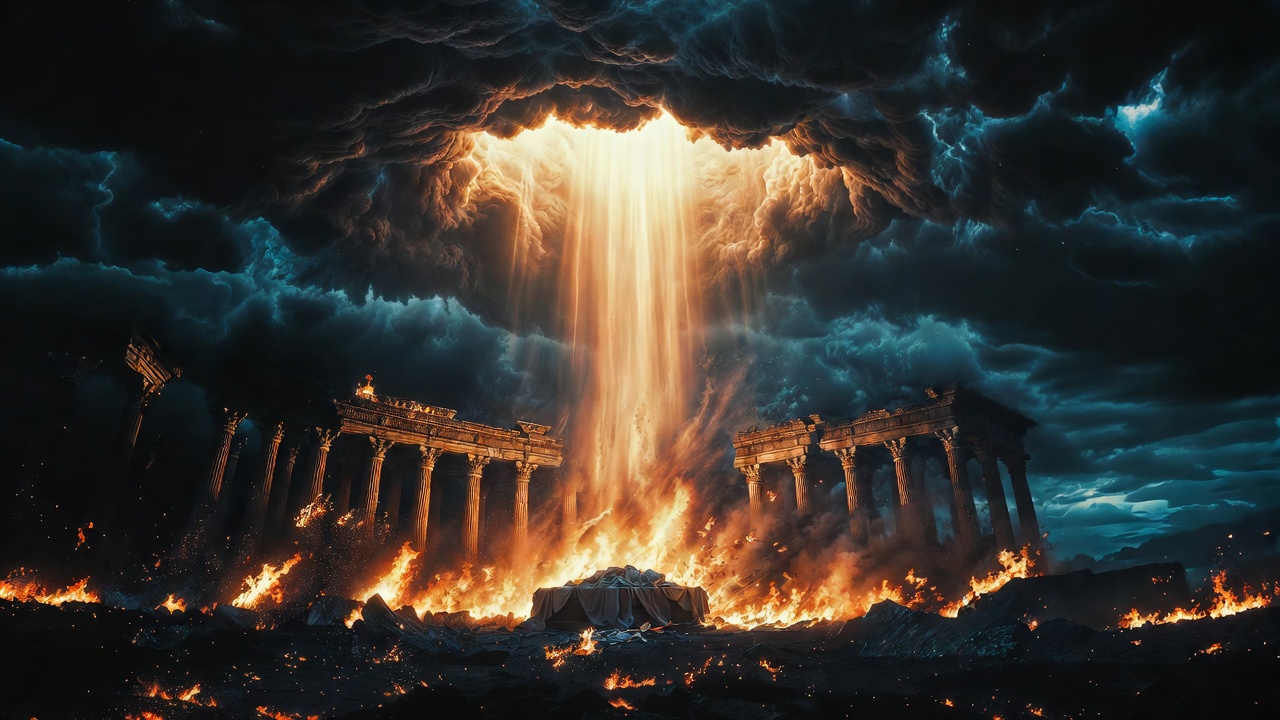
Immediately upon Solomon’s “Amen,” God answers in unmistakable power: fire falls from heaven, consuming the sacrifices, and the glory of the Lord fills the temple so completely that the priests cannot enter. The people respond in awe-filled worship, proclaiming the ancient refrain, “For he is good, for his steadfast love [hesed] endures forever.” The entire scene confirms that the temple has been accepted as the place where heaven and earth meet, where sinners may approach a holy God through sacrifice and prayer.
Podcast Episode

Video Summary
Commentary
2 Chronicles 6:12
Then he stood before the altar of the Lord in the presence of all the assembly of Israel and spread out his hands.
Solomon’s opening posture is both royal and reverent. He positions himself directly in front of the great bronze altar in the inner court, facing the temple, with the entire nation watching. Spreading out the hands (Hebrew pāraś H6566) was a customary gesture of supplication and openness to receive from God, seen also in Moses . By doing this publicly, Solomon models for Israel that even the king must approach God with empty, uplifted hands — nothing to offer but dependence. The act also echoes the priestly posture, reminding the people that the Davidic king serves as a mediator between God and the nation at this sacred moment.
2 Chronicles 6:13
Solomon had made a bronze platform five cubits long, five cubits wide, and three cubits high, and had set it in the court, and he stood on it. Then he knelt on his knees in the presence of all the assembly of Israel, and spread out his hands toward heaven,
This verse reveals extraordinary humility. The platform — approximately 2.3 meters square and 1.4 meters high — was crafted specifically for this occasion so that every Israelite gathered in the vast temple courts could see their king. Standing first, Solomon then does something rare for a Near Eastern monarch: he kneels (Hebrew bārak H1288, literally “to bend the knee” in worship). Kings typically remained standing or seated on thrones; kneeling was reserved for subjects before superiors. By kneeling before the Lord in full view of the nation, Solomon visibly declares that Yahweh, not he, is the true King of Israel (cf. Psalm 95:6). This act foreshadows the greater King who would one day kneel in an olive garden and pray with strong crying and tears .
2 Chronicles 6:14
and said, “O Lord, God of Israel, there is no God like you, in heaven or on earth, keeping covenant and steadfast love with your servants who walk before you with all their heart,
Solomon begins with pure worship, echoing Moses’ song after the Red Sea . Solomon roots the entire dedication in grace: the temple exists not because Israel deserves it, but because God keeps His promises to those who love Him.
2 Chronicles 6:15–17
you who have kept with your servant David my father what you declared to him. You spoke with your mouth, and with your hand have fulfilled it this day. Now therefore, O Lord, God of Israel, keep for your servant David my father what you have promised him, saying, ‘You shall not lack a man to sit before me on the throne of Israel, if only your sons pay close attention to their way, to walk in my law as you have walked before me.’ Now therefore, O Lord, God of Israel, let your word be confirmed, which you have spoken to your servant David.
Solomon celebrates the fulfillment of the Davidic covenant already realized — the temple stands as proof that God has kept His word to David .
2 Chronicles 6:18
“But will God indeed dwell with man on the earth? Behold, heaven and the highest heaven cannot contain you, how much less this house that I have built!
Here Solomon confesses both God’s transcendence and His gracious immanence. The rhetorical question acknowledges that even the highest heavens cannot contain God .
2 Chronicles 6:19–21
Yet have regard to the prayer of your servant and to his plea, O Lord my God, listening to the cry and the prayer that your servant prays before you, that your eyes may be open toward this house night and day, toward the place where you have promised to set your name, that you may listen to the prayer that your servant prays toward this place. And listen to the plea of your servant and of your people Israel, when they pray toward this place. And listen from heaven your dwelling place, and when you hear, forgive.
Solomon’s central request is that God would “hear from heaven” whenever prayer is directed toward this temple. The repetition of “toward this place” anticipates the practice of later generations — even in exile — turning toward Jerusalem in prayer . The ultimate purpose is forgiveness, revealing that the temple system exists not primarily for ritual but for restored relationship with a holy God.
(Verses 6:22–39 contain seven specific petitions. For brevity in this format, key insights are highlighted rather than repeating full verse text each time.)
2 Chronicles 6:22–23 (Oath before the altar)
Solomon asks God to act as righteous Judge when disputes are brought to the temple for swearing oaths. This reflects the temple’s role as the supreme court of the nation, where God Himself vindicates the innocent and condemns the guilty.
2 Chronicles 6:24–25 (Defeat because of sin)
When Israel is defeated by enemies because of sin, repentance and prayer toward the temple should move God to forgive and restore. This petition prophetically covers the later Assyrian and Babylonian conquests and points to the pattern of confession leading to restoration.
2 Chronicles 6:26–27 (Drought)
Drought was understood as divine discipline . Solomon pleads that sincere repentance would bring both forgiveness and rain, teaching Israel to look to God alone for physical as well as spiritual provision.
2 Chronicles 6:28–31 (Famine, plague, etc.)
Every conceivable calamity is covered, with the repeated condition: “if they pray toward this place…then hear from heaven…that they may fear you and walk in your ways.” The goal is not merely relief but lifelong reverence.
2 Chronicles 6:32–33 (The foreigner)
Remarkably, Solomon prays for Gentiles who come from afar drawn by God’s fame. This foreshadows the temple as a “house of prayer for all peoples” and the Great Commission itself.
2 Chronicles 6:34–35 (War)
When Israel goes to battle at God’s command, prayer toward the temple should bring divine help, affirming that victory belongs to the Lord.
2 Chronicles 6:36–39 (Exile because of sin)
The final petition prophetically anticipates the Babylonian exile: when the people sin, are carried away, then repent “with all their heart and soul” in the land of their captors and pray toward Jerusalem, God will hear, forgive, and restore. This became the hope of Daniel and generations in captivity.
2 Chronicles 6:40–42
“Now, O my God, let your eyes be open and your ears attentive to the prayer of this place. And now arise, O Lord God, and go to your resting place, you and the ark of your might. Let your priests, O Lord God, be clothed with salvation, and let your saints rejoice in your goodness. O Lord God, do not turn away the face of your anointed one; remember your steadfast love to David your servant.”
Solomon closes by quoting and adapting Psalms , asking God to take up residence with the ark and to remember His hesed promises to David. The prayer ends on the note of covenant loyalty.
2 Chronicles 7:1
As soon as Solomon finished his prayer, fire came down from heaven and consumed the burnt offering and the sacrifices, and the glory of the Lord filled the house.
God’s immediate, dramatic answer leaves no doubt: the temple is accepted. Fire from heaven had authenticated the tabernacle . Now it authenticates Solomon’s temple. The double sign — fire consuming the offerings and glory filling the house — shows complete divine approval.
2 Chronicles 7:2
And the priests could not enter the house of the Lord, because the glory of the Lord filled the house of the Lord.
The cloud of glory (the Shekinah) so overwhelmed the temple that even the consecrated priests could not perform their duties (cf. Exodus 40:35; 1 Kings 8:11). This demonstrates that God’s presence is not automatic but a sovereign gift, and that His holiness is undiminished even in the midst of His people.
2 Chronicles 7:3
And when all the people of Israel saw the fire come down and the glory of the Lord on the house, they bowed down with their faces to the ground on the pavement and worshiped and gave thanks to the Lord, saying, “For he is good, for his steadfast love endures forever.”
The entire nation responds in unified worship, prostrating themselves on the stone pavement of the court. Their confession is the great refrain of corporate praise in Israel , rooted in the exodus deliverance. The enduring hesed of God — celebrated in Solomon’s prayer, confirmed by fire and glory — now becomes the people’s spontaneous song. Heaven and earth have met, sin has been covered, and the covenant God has shown Himself faithful once again.



Leave a Reply