
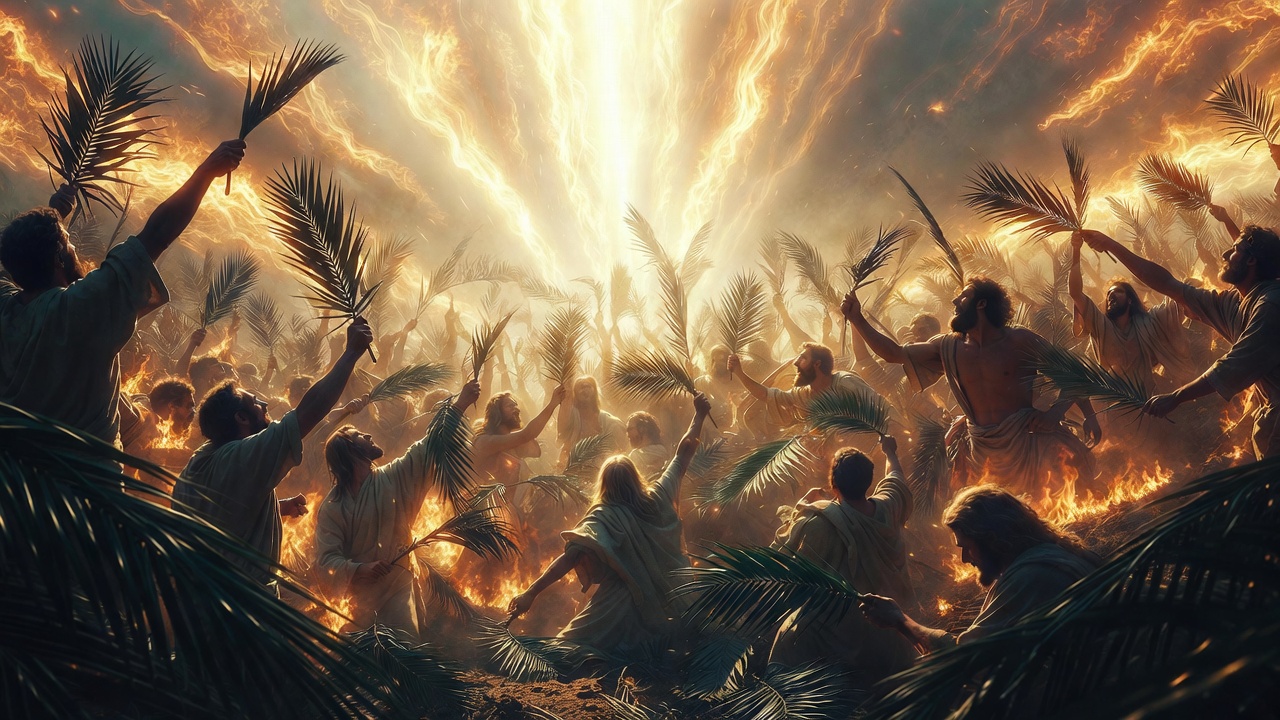
In the unfolding drama of John’s Gospel, immediately after the resurrection of Lazarus that sparked both faith and fierce opposition, Jesus approaches Jerusalem for the Passover feast. A massive throng of pilgrims, electrified by eyewitness accounts of that miracle, surges out to greet Him in a spontaneous outpouring of messianic hope. They wave palm branches—a symbol steeped in Jewish history of national deliverance—and cry out words drawn straight from the Hallel psalms sung by worshippers ascending to the temple. Jesus deliberately chooses a young donkey as His mount, enacting the ancient prophecy of a coming King who brings peace rather than war. This moment, often called the Triumphal Entry, publicly declares His royal identity while setting the stage for the cross. Yet the acclaim is tragically mixed with misunderstanding; the crowds envision political liberation from Rome, unaware that the true King has come to conquer sin and death through humble obedience and sacrifice. The passage closes with the alarmed reaction of the religious leaders, revealing how God sovereignly uses even misguided enthusiasm to advance His redemptive plan.
The event stands as a vivid portrait of contrast: outward triumph masking inward sorrow, popular praise soon to turn to rejection, and prophecy fulfilled in ways far deeper than anyone yet grasped. The disciples themselves only comprehend its full weight after Jesus is glorified, underscoring the Spirit’s role in illuminating Scripture. This entrance, covering roughly three kilometers from the village of Bethany on the eastern slopes of the Mount of Olives into the holy city, pulses with the electric atmosphere of Passover when Jerusalem swelled with pilgrims longing for God’s deliverance. It invites every reader to examine whether we welcome Christ on His terms—as the Servant-King who rides to die—or reshape Him into our own expectations of power and victory.
Podcast Episode


Video Summary
John 12:12
“The next day the large crowd that had come to the feast heard that Jesus was coming to Jerusalem.”
The timing could not have been more charged; “the next day” places this on the heels of the supper in Bethany where Mary anointed Jesus, a quiet act of devotion amid growing shadows. A “large crowd” (Greek ochlos polys—a teeming multitude) of festival pilgrims had converged on Jerusalem for Passover, the annual reminder of God’s deliverance from Egypt. Word of Jesus’ approach spreads like wildfire because the recent raising of Lazarus had become the talk of every pilgrim caravan. In Jewish tradition, Passover pilgrims traveled in festive groups, singing the Psalms of Ascent, their hearts primed for the long-awaited Messiah who would finally crush Israel’s oppressors. Here the crowds sense that moment has arrived, yet their excitement is fueled more by spectacle than by surrendered faith. This verse quietly sets the stage for the collision of heaven’s agenda with earth’s hopes, reminding us that God often draws people to Jesus through signs and wonders, even when their initial motives fall short of true discipleship. The same Jesus who once told seekers not to publicize His miracles now allows the testimony of Lazarus to propel Him into the spotlight of prophecy’s fulfillment.
John 12:13
“So they took branches of palm trees and went out to meet him, crying out, ‘Hosanna! Blessed is he who comes in the name of the Lord, even the King of Israel!’”
Palm branches carried rich symbolism in Jewish life: emblems of victory and rejoicing, used at the Feast of Tabernacles (Leviticus 23:40) and in celebrations of national triumph such as the Maccabean deliverance. By waving them at Passover, the crowds were instinctively declaring Jesus the new liberator who would shatter Rome’s yoke just as God had shattered Pharaoh’s. Their shout “Hosanna!” is the Hebrew hoshia na—“save now!”—taken directly from Psalm 118:25, part of the Egyptian Hallel (Psalms 113–118) that families recited around Passover tables and pilgrims sang as they climbed to the temple. The addition “even the King of Israel!” echoes the royal hopes of Zechariah and the prophets. In that culture, such a procession mirrored the welcome given to conquering heroes or kings, yet Jesus receives it while riding toward a cross. This gem shines brightly: the very words of praise that welcomed the King also prophetically pointed to His sacrificial death, for Psalm 118 also speaks of the stone the builders rejected becoming the cornerstone. The crowd’s enthusiasm was genuine but incomplete; they longed for a Messiah who would save them from their enemies rather than save them from their sins.
John 12:14
“And Jesus found a young donkey and sat on it, just as it is written,”
Deliberately and without fanfare, Jesus locates a young donkey—never before ridden, set apart for sacred use in Jewish eyes—and mounts it. This simple act is drenched in meaning. In the ancient Near East, a king riding a donkey signaled peaceful intent and legitimate rule, in contrast to war horses that spoke of conquest by force. The phrase “just as it is written” alerts us that every detail unfolds according to Scripture’s script. Jesus is not swept along by the crowd’s fervor; He orchestrates the moment to declare, “I am the promised King, but My reign looks nothing like you expect.” In a culture where donkeys were humble beasts of burden, the King of glory chooses lowliness, modeling the very servant heart He would soon display by washing feet and laying down His life. This verse whispers a profound truth: true royalty is revealed in meekness, and the path to the throne passes through the valley of the cross. The disciples later grasped that this was no improvisation but the sovereign King fulfilling what the Father had ordained centuries before.
John 12:15
“Fear not, daughter of Zion; behold, your king is coming, sitting on a donkey’s colt!”
Here John quotes Zechariah 9:9, weaving the Old Testament promise directly into the living scene. “Daughter of Zion” tenderly addresses Jerusalem as God’s beloved, and the command “Fear not” echoes the comfort God repeatedly gave His people before great deliverances. The colt (pōlon) of a donkey underscores humility and peace; the coming King would “speak peace to the nations” (Zechariah 9:10). In first-century Jewish expectation, many looked for a warrior Messiah on a white horse, yet Zechariah painted a picture of gentle strength. Jesus embodies both the exalted King and the suffering Servant, riding not to seize a throne by force but to be lifted up on a cross so that He might draw all people to Himself. This prophecy’s fulfillment is a treasure: God’s Word is so precise that even the mode of transportation was foretold, proving Jesus is the exact match to every promise. For us today it reassures that when our King seems to come in unexpected, even disappointing ways, He is still fulfilling the Father’s perfect plan.
John 12:16
“His disciples did not understand these things at first, but when Jesus was glorified, then they remembered that these things had been written about him and had been done to him.”
The disciples, so close to Jesus, still missed the prophetic depth until the resurrection and the Spirit’s illumination. The Greek word for “glorified” points to the cross and resurrection as the supreme revelation of Jesus’ glory. This honest admission protects us from spiritual pride; even those who walked with the Lord needed time and the Holy Spirit to connect the dots. Jewish education steeped them in Scripture, yet only after the events did the pieces lock together like a divine puzzle. The verse offers a beautiful gem: God is patient with slow learners. The same Scriptures that puzzled them then are now opened to us by the risen Christ, just as He opened the minds of the Emmaus disciples. It also warns that head knowledge alone is never enough; true understanding blooms only in the light of the empty tomb and the indwelling Spirit.
John 12:17
“The crowd that had been with him when he called Lazarus out of the tomb and raised him from the dead continued to bear witness.”
Those who stood at the tomb when Jesus cried, “Lazarus, come out!” could not stay silent. Their testimony spread like ripples from a stone thrown into a pond, drawing even more people to line the road. In Jewish legal thought, multiple eyewitnesses carried great weight, and here a whole group of credible witnesses kept declaring what they had seen. This verse highlights a key principle: personal encounter with Jesus’ power naturally produces testimony. The miracle was not a private show but public evidence meant to point to the greater resurrection soon to come. Even as the religious leaders plotted to kill Lazarus too (John 12:10), these witnesses refused to be silenced. Their persistence foreshadows the unstoppable witness of the early church after Pentecost, when ordinary people who had seen the risen Lord turned the world upside down.
John 12:18
“The reason why the crowd went to meet him was that they heard he had done this sign.”
John repeats the motive to underscore that the Lazarus miracle was the catalyst. The Greek sēmeion (“sign”) reminds us that Jesus’ works were never random wonders but deliberate pointers to His identity as the Son of God. In a culture where signs were expected of the Messiah, this one—raising a man dead four days—carried explosive force. Yet the crowds followed the sign rather than the Sign-Giver. This verse gently probes the heart: do we seek Jesus for what He can do for us, or for who He is? The same danger exists today; many are drawn by answered prayer or felt needs, but only those who press past the sign to worship the Savior remain when the road turns toward Calvary. God mercifully uses signs to awaken faith, yet He calls us beyond them to lifelong allegiance.
John 12:19 “So the Pharisees said to one another, ‘You see that you are gaining nothing. Look, the world has gone after him.’”
The religious leaders’ despair drips with irony. The Greek kosmos —“the world”—here means the teeming crowds, yet it prophetically hints at the Gentiles who would soon believe and the global harvest Jesus would reap through His death. Their frustrated admission unwittingly echoes Psalm 2: “Why do the nations rage?” They see their influence crumbling and recognize the unstoppable momentum, yet they refuse to bow. In Jewish leadership tradition, maintaining control over the people was paramount to avoid Roman crackdown, but their power plays only hastened the very events they feared. This closing verse is a solemn gem: opposition to Christ ultimately testifies to His supremacy. Even the enemies’ words become unwitting praise, for when the whole world seems to follow Jesus, heaven smiles and redemption draws near. It challenges every generation: will we join the Pharisees in resisting, or join the crowd—then go further—and truly crown Him King in our hearts?
This passage closes the door on public ministry and flings open the door to the cross, inviting us to examine our own welcome of the King who comes not to meet our expectations but to meet our deepest need.



Leave a Reply