
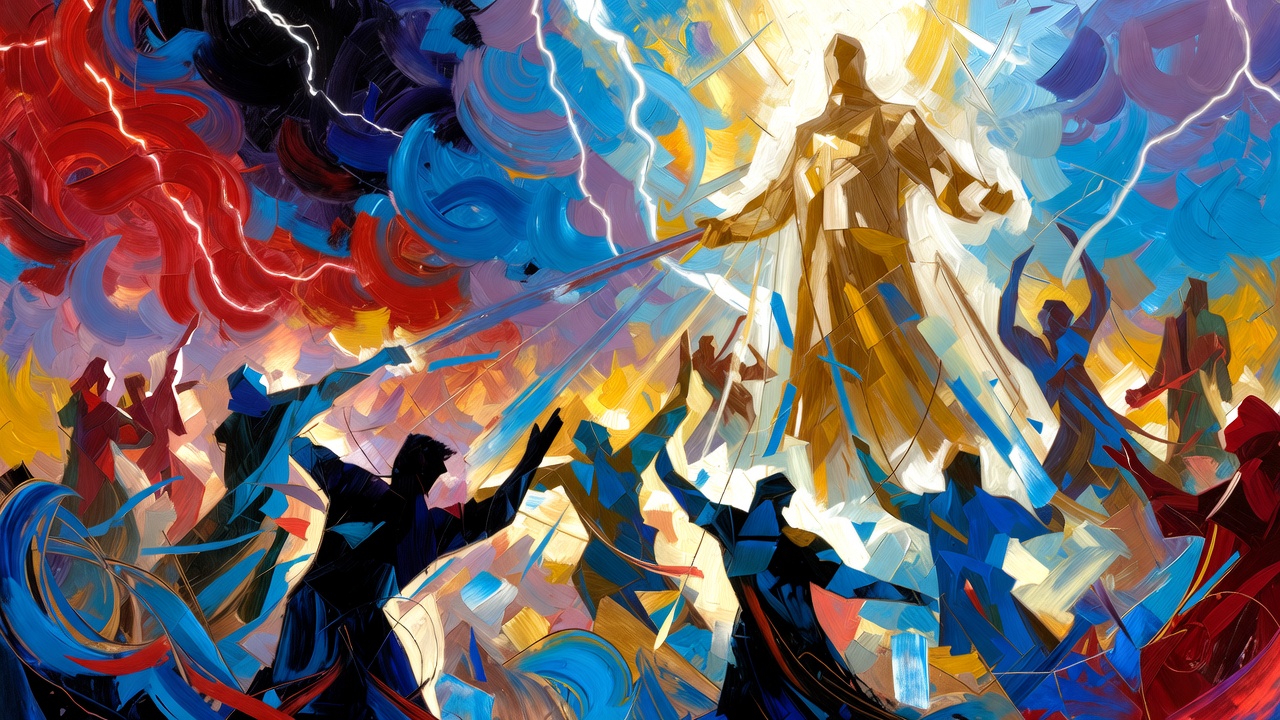
Psalm 2 is a powerful royal psalm that reveals God’s sovereign rule over the nations and His anointed King. Ultimately, it points to the Lord Jesus Christ as the triumphant Son who will inherit all authority. The psalm unfolds in four stanzas: the rebellion of the earth (vv. 1–3), God’s response from heaven (vv. 4–6), the decree of the Son (vv. 7–9), and the call to submit (vv. 10–12). Below is a verse-by-verse commentary.
Podcast Episode


Video Summary
Commentary
Psalm 2:1
Why do the nations rage and the peoples plot in vain?
The psalm opens with a piercing question that exposes the futility of human opposition to God. The word “rage” translates the Hebrew rāgaš, which describes a restless, tumultuous assembly — like a mob stirring itself into frenzy. “Plot” comes from hāgâ, meaning to murmur or devise empty schemes. From the very beginning, Scripture declares that all rebellion against the Lord is ultimately “in vain” — empty and doomed to fail. This verse is quoted in Acts 4:25–26 where the early church recognized its fulfillment in the conspiracy against Jesus by Herod, Pilate, the Gentiles, and Israel. The nations may gather in defiant council, but their plans cannot overturn God’s purposes.
Psalm 2:2
The kings of the earth set themselves, and the rulers take counsel together, against the Lord and against his Anointed, saying,
Earthly rulers “set themselves” (Hebrew yāṣab — to take a stand in opposition) and unite in deliberate rebellion. The key title here is “his Anointed” (Hebrew māšîaḥ, Messiah), the one chosen and empowered by God. In David’s day this referred to the king of Israel, but the New Testament repeatedly applies it to Christ (see the same quotation in Acts 4:25–26). The united front of political powers against the Lord and His Christ reveals the deep-seated enmity of the human heart toward divine authority. Yet their counsel only serves to fulfill God’s greater plan.
Psalm 2:3
“Let us burst their bonds apart and cast away their cords from us.”
The rebels speak openly: they view God’s rule and the reign of His Anointed as intolerable “bonds” and “cords.” In ancient Jewish thought, cords could symbolize the yoke of a king or the binding obligations of covenant loyalty. The nations want complete autonomy — no moral restraints, no divine law. This is the essence of sin: the creature shaking its fist at the Creator, declaring independence. Tragically, this same spirit appears throughout history and is vividly seen in the rejection of Jesus, the true King.
Psalm 2:4
He who sits in the heavens laughs; the Lord holds them in derision.
In stark contrast to earthly turmoil, God is enthroned in perfect sovereignty. He “laughs” — not in cruel mockery but in sovereign derision at the absurdity of finite creatures opposing the infinite Creator. The Hebrew śāḥaq here carries the sense of scoffing at something utterly ridiculous. God is never threatened; rebellion only highlights His unchallenged authority. This laughter reassures believers that no conspiracy against God’s kingdom can succeed.
Psalm 2:5
Then he will speak to them in his wrath, and terrify them in his fury, saying,
God’s laughter gives way to righteous wrath. He speaks not in panic but in fury, and the rebels are “terrified” (Hebrew bāhal — to tremble in sudden alarm). Divine judgment is certain and overwhelming. Though patient now, God will not forever endure defiance against His holy rule and His anointed King.
Psalm 2:6
“As for me, I have set my King on Zion, my holy hill.”
God answers the rebellion with an unshakeable declaration: He has already installed His King. “Set” translates nāsak, meaning to pour out (as in anointing) or to establish firmly. Zion, the hill in Jerusalem where the temple would stand, is called God’s “holy hill” — His chosen dwelling place among His people (about 760 meters above sea level, the prominent ridge in ancient Jerusalem). Ultimately this points to Christ’s enthronement at God’s right hand .
Psalm 2:7
I will tell of the decree: The Lord said to me, “You are my Son; today I have begotten you.”
The anointed King now speaks, proclaiming the divine decree. “Begotten” does not imply creation but unique sonship and installation as king (a common ancient Near Eastern coronation formula). The Father’s declaration at Jesus’ baptism and transfiguration echoes this exact language , confirming His eternal sonship and royal authority.
Psalm 2:8
Ask of me, and I will make the nations your heritage, and the ends of the earth your possession.
The Father offers an unlimited inheritance: all nations and the farthest reaches of earth. This promise far exceeds David’s earthly kingdom; it finds fulfillment in Christ’s great commission and worldwide dominion . The gospel is the means by which the nations become Christ’s possession.
Psalm 2:9
You shall break them with a rod of iron and dash them in pieces like a potter’s vessel.”
The Messiah’s rule is both gracious and firm. The “rod of iron” symbolizes unyielding authority that shatters resistance like fragile pottery. This imagery is applied to Christ’s return in judgment . Rebel kings and nations will face irreversible consequences if they persist in opposition.
Psalm 2:10
Now therefore, O kings, be wise; be warned, O rulers of the earth.
A gracious warning follows the threat of judgment. Wisdom consists in heeding God’s revelation and submitting to His King. Earthly rulers are called to humble themselves before it is too late.
Psalm 2:11
Serve the Lord with fear, and rejoice with trembling.
True wisdom expresses itself in reverent service and joyful awe. “Fear” and “rejoice” are not contradictory; genuine worship combines deep reverence with exultant joy. The phrase captures the balanced posture every believer — and every ruler — should have before the holy, sovereign God.
Psalm 2:12
Kiss the Son, lest he be angry, and you perish in the way, for his wrath is quickly kindled. Blessed are all who take refuge in him.
The psalm closes with an urgent call to homage. “Kiss the Son” is an act of submission and loyalty — ancient subjects kissed the feet or hand of a king to pledge allegiance. The word “Son” here is bar (Aramaic for “son,” used for emphasis in this Hebrew psalm), underscoring the royal Son’s distinct authority. Refusal brings swift destruction; submission brings blessing. The final beatitude — “Blessed are all who take refuge in him” — offers gospel hope: safety and happiness are found only in trusting and submitting to God’s anointed King, the Lord Jesus Christ.


Leave a Reply